Showing posts with label climate change. Show all posts

Thursday, May 29, 2008

Is geoengineering a viable solution to climate change?

With climate change a real and increasing threat, scientists are coming up with more and more bizarre methods of prevention or reversal. Amongst those cited in an article in The Guardian are
  • putting 1.9 million tonnes of cooling sulphur into the atmosphere, via ballooons;
  • placing iron particles in the ocean to increase carbon-absorbing phytoplankton, a form of marine carbon sequestration;
  • using large tubes which will move vertically with waves and pump cooler water and nutrients to the ocean's surface and encourage the growth of phytoplankton;
  • using giant platforms to re-ice the Arctic by spraying salty water onto ice, thereby increasing its thickness and preventing an onslaught of fresh water when the ice melts in summer, in effect maintaining the threatened Gulf Stream;
  • placing light refractors between the earth and the sun to reflect some of the sun's rays back into space. (Far out!)
Freaky? I think so. But perhaps not as freaky as the alternative. Let's hope it doesn't come to that. For the full story see http://www.guardian.co.uk/technology/2008/may/29/greentech.geoengineering

Whilst we're on the subject of climate change, one of my favourite topics has raised its head again: the environmental impact of aviation, that is can flying ever be "green"? The London Science Museum is housing an exhibition titled "Does flying cost the Earth?" until November. It looks at the effect flight has on climate change and the new technologies being considered by the aviation industry in an attempt to green up aeroplanes and keep the industry going in a world increasingly concerned by CO2 emissions. I wish I could go. This is one of the things I miss about London. Would someone please go on my behalf and report back?

Coincidentally, perhaps, next week is World Environment Day and the University is hosting the Sunshine Coast World Environment Day festival this Saturday. I had intended to be really green and go along on my bike but a couple of things are putting me off. Firstly, I have recently been suffering from a really sore back following lengthy bike rides, which is a bit annoying as I have been quite enjoying my rides to work. Secondly, the weather is going to be rubbish, otherwise I'd walk. It's only 7.5 km which would be quite pleasant on a nice day. On a rotten minging day, however, it would be very unpleasant so I'll either take the bus or, more likely, drive. If I do make it there, and it's interesting, I shall endeavour to report back next week.

Tuesday, May 27, 2008

Climate change in Google Earth

Climate Change In Our World is a new Google Earth layer developed by the Met Office Hadley Centre demonstrating current climate change predictions. It's an excellent tool for communicating what climate change can (and will) do to our world and I encourage all of you with Google Earth installed to download the layer.


There is a time line across the top, which you can either slide to a particular year to see what the temperature increase would be, or which you can play as an animation, watching the temperature rise as time goes by. The timeline goes from 1999 to 2099. There is a second animation which flies you around the earth to areas of specific interest, where you can click on an icon and read stories of how climate change is already impacting the world.

Fly over to the Artic Circle and watch the temperature increase at an astonishing rate. By 2018 it is approximately 8 or 9 degrees (celsius) warmer than in 1999; by 2043 it is around 12°C warmer and by the end of the animation in 2099 it has increased by an incredible 18°C. The data used to produce the layer are based upon a mid-range IPCC emissions scenario.

A second Climate Change In Our World Google Earth layer has been produced by the British Antartic Survey and demonstrates the retreat of the Antartic ice shelves over the past 50 years.


These are great educational tools for both adults and kids with links to resources offering further information and practical advice.

Incidentally, I took this opportunity to update my version of Google Earth and installed the latest beta (4.3). It's great. It has its own browser so any links you click on open in the Google Earth window and it comes with lots of really interesting layers. Those that I have found of interest in the few moments I have spent madly clicking around are the National Geographic Magazine layer (under Gallery) and The Earth from Above with GoodPlanet (under Global Awareness) but there are loads of others.


After rediscovering my love of Google Earth I downloaded another layer which demonstrates World Oil Consumption using data from the CIA World Factbook. Fascinating. Next, I think I shall play with rising sea levels. I mean that from a purely educational Google Earth perspective, not from an evil-world-domination-I-like-to-think-I-am-God perspective.

Wednesday, February 06, 2008

The Shift: A movie about an evolutionary shift in the collective consciousness

I stumbled across this film clip this morning on a blog called We The Change. I thought it was pretty cool and that it should be shared. Unfortunately it seems the film-makers are still raising funds to finish the movie so I don't know when it's likely to be released.


If you have some spare cash lying around and you're in the business of supporting independent film-makers then you can make a donation at The International Documentary Association website. Visit the film's website at The Shift Movie.

Tuesday, October 17, 2006

Sunrise solar panel petition update

Australian Channel Seven's Sunrise show reaches 55,000 signatures on their online petition against the government's decision to phase out solar panel rebates in 2007.

I am still amazed at the effect the morning TV show, Sunrise (and others) can have on the collective consciousness of the nation. When I signed their solar panel rebate petition two weeks ago (see http://linsdownunder.blogspot.com/2006/10/sign-solar-panel-rebate-petition.html) approximately 3000 people had signed up. Since then Sunrise have relentlessly promoted their Cool the Globe campaign which, incidentally is a crazy name for a climate change awareness campaign. If people think we can actually cool the globe then they're going to be a little disappointed. All we can really hope to do is prevent it from over-heating as much as we can.

This morning they excitedly announced that they had hit the 49,000 mark. We were discussing this in the office when my colleague, Linda decided to sign the petition. After submission of the form she was redirected to the last page of the petition to view her name upon it. Between the form being submitted and the page displaying in her browser approximately 10 others had also signed the petition so her name actually appeared towards the top of the page rather than last on the list. Not only that but, following the hype on TV this morning, they now had over 55,000 signatures. That's 6,000 signatures in three or four hours!! A few minutes later, Linda's signature was about 5 pages from the end of the petition. In the time it has taken me to write this post, which is about an hour and a half as I've been doing it at work whilst waiting for things to load on my computer, another 1,000 signatures have been collected and they are now not far off the 57,000 mark.

Imagine the difference that could be made if these 57,000 people began making small changes to their lives, such as replacing tungsten light globes with fluroescent bulbs, turning the hot water tap down in the shower rather than the cold water tap up, switching lights off when leaving the room, participating in clean energy programs, walking or cycling short distances instead of always taking the car, participating in carbon neutralisation schemes and so much more.

I really feel a change is about to happen and it's a great feeling.

Friday, October 06, 2006

Ride to work... walk to work

Apparently Wednesday was Ride to Work Day and today is Walk to Work Day, a fact that seems to have gone unnoticed by the University of the Sunshine Coast where I work. This is surprising considering they have a research centre for Healthy Activities and Sports Exercise (CHASE), which runs a Healthy Lifestyle Program for students and staff, providing a small number of activities and facilities, such as a walking group, yoga, pilates, weights, karate.

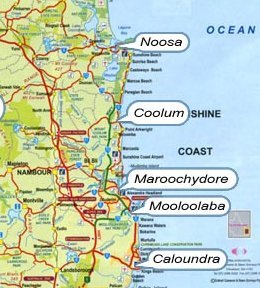
I wondered whether this oversight was to do with the layout, and therefore attitude of the Sunshine Coast, which is very much a car society. The Sunshine Coast is like a city that is growing from the outside in. There is no one CBD as such, and many of the residential areas are semi-rural or just miles away from the urban business districts. The large employers are the councils and the university. The university itself is "out in the sticks" although a small commercial district is beginning to grow not too far away. Public transport is better than nothing - I catch the bus to work most days but I live in a fairly developed and central area. Some colleagues of mine have to leave the office by 5pm in order to catch the last bus home, which isn't much of an incentive to use public transport, and cycling and walking are almost out of the question to all but the exceptionally fit (and crazy) due to the distances involved.

Map of the Sunshine Coast and its many urban centres from www.qldtravel.com.au


With this in mind I emailed CHASE to find out why they weren't doing more to promote these campaigns, and to suggest that next year they follow the lead of Noosa Council, whose Travel Smart initiative provided a free breakfast for those employees taking part. Apparently CHASE weren't even aware of these campaigns.

I have to admit that I didn't ride or walk on either of these days but I cycle every Tuesday anyway and this morning I got off the bus a stop early. However, Toby cycled 45km (28 miles) from our house in Buddina to his office in Tewantin yesterday, proving that it can be done if you really want to. He also car-pools quite regularly, which just shows that we can change our habits to travel more efficiently if we put our minds to it. It just requires a bit of thought, preparation and cooperation.

Speaking of commerative days, my colleague Linda declared today to be Chiton Day. Chitons are intertidal zone molluscs. This is the kind of stuff you inadvertantly learn when you work at a university.

A chiton in its natural intertidal habitat from www.wikipedia.com

Thursday, October 05, 2006

Sign the solar panel rebate petition

Wow! This Al Gore movie is really ramping things up in the climate change arena. Sunrise (Australian Channel 7's morning TV show) have stuck their teeth in with regular reports on climate change and practical advice on what we can all do to help combat it. And now, in response to the government's plan to phase out the already reduced solar panel rebate, they have set up an online petition to keep the rebate. If you're interested in signing the petition (please do) then head to http://sunrisefamily.com.au/current/petition/index.php. Unfortunately there doesn't seem to be any useful information relating to climate change here or on the rest of the Sunrise website... but sign the petition anyway.

Friday, September 29, 2006

Get on the climate change map

This is one for the Aussies. Nirvana has just sent through this link to a petition to the Australian government to make some positive changes towards climate change. They will use the basic information they get from campaigners to create a map of those concerned. Let's get as many people on that map as possible:
Put me on the Get Up map

And don't you Brits think you're getting out of it that easily either. There's an international climate change march happening on Saturday 4th November. For details on where the marches are happening and how to get involved, and of other climate change related campaigns check out www.campaigncc.org.

Aussies can check out www.walkagainstwarming.org for details of marches being organised in the major cities.

Wednesday, September 27, 2006

Please see An Inconvenient Truth

We went to see Al Gore's film An Inconvient Truth last night and it was excellent. I fully recommend it to anyone and will be pestering everyone I know to see it.

For those that aren't aware, it's basically Al Gore presenting a slide show on climate change. This is something he studied at college and has spent most of his political life trying to raise awareness of. When he lost the presidential elections back in 2000 he decided to travel the world presenting his slide show and educating people on the causes, consequences and prevention of climate change as well as a bit of the science and history behind it. The movie is his way of reaching even more people (and hopefully cutting down on his international air travel).

For those that don't know that much about climate change, the movie is very informative. There wasn't a lot in it that I didn't already know from reading books and websites but the movie is much more engaging than a book. The fact that everything he talks about is accompanied by photographs, cartoons, graphs or charts makes it more interesting, more visual and easier to take in. And just so that you're not sitting there with your eyes glazing over thinking "what's he talking about again?", there are personal moments of tragedy and revelation which contributed to Gore's passion for the subject. The movie is aimed at the American public but is very relevant to everyone else too.

The thing is, whether we like it or not, climate change IS happening. I know I've said before that I don't want to use this blog to preach, mainly because I don't want to put people off coming here and reading it, but at the end of the day it's vitally important that everyone understands as much as they can about this subject. Throughout history change has occurred because the people, the general population, have wanted it, have fought for it and have put pressure on those organisations that can actually do something about it. Politicians won't make the changes unless we want them to. Energy companies, airlines, car manufacturers won't make the changes unless we pressure them to. Every purchasing decision we make has a direct influence on climate change in some way. It is up to every single one of us to make all the small changes we can, which will ultimately contribute to a big change, and which will hopefully lessen the consequences of climate change and give us the ability to deal with it when it does happen.

When you do see the film, be sure to stay right to the end as some interesting and useful snippets of advice come up during the credits. This is the important bit as this is what empowers you to actually help the situation. Here is a youtube.com trailer of the movie:


For an alternative (and funny) trailer see: A Terrifying Message from Al Gore

And for an amusing review see: Keep it Green! Cliff Notes Version of An Inconvenient Truth

Interestingly, whilst I was writing this post Toby's brother called to say that the environment minister was being interviewed on Sunrise, Australia's top morning TV show. He was talking about the film and about the issue of climate change. I missed the interview but tuned in in time to hear the presenter give a couple of shocking statistics and to promise to revisit the topic over the next few months. This is brilliant and this means the issue is being brought to the masses. Bring it on!

Tip for the top: Get involved in your energy company's green energy scheme. This is a very easy thing to do but can have a massive overall effect. Toby and I purchase 1000kw of renewable energy per quarter from Energex, which is about how much electricity we use. In effect, this means that all of our energy comes from renewable resources, hardly any of it comes from dirty polluting coal. Most of our renewable energy comes from bio-mass which is a controversial source of renewable energy as some say it isn't actually renewable. Basically, rubbish in landfill gives off methane, which is 20 times more potent a greenhouse gas than CO2. Instead of letting this energy into the atmosphere, the energy companies convert it into electricity, thus helping the climate in two ways; firstly by preventing the release of that methane, and secondly by replacing (or, more accurately, reducing) the need to burn CO2 producing coal. The energy companies generally get their renewable energy from a number of sources and each scheme will place more emphasis on different types of resources. We pay a little bit extra each bill for the privelege of placing the renewable energy onto the grid, which I personally think is a bit ridiculous: it's like we're being taxed for using clean energy instead of the other way round. But, it's really not a lot of money when you consider the total cost of your bill and I think it's worth it for peace of mind.

Attention all teachers! My second tip for the top today is a request for all teachers to do everything they can to either get their students to see this movie if they're old enough or, for the younger ones, to find some alternative way of educating them on climate change and the small things they can do to help. I know that children can have a massive influence on their parents and can help to educate them, and the principles they learn at school will stay with them for life. I will always remember "Waste not, want not" and to this day can't leave food on my plate. My Grandpa gave up smoking after my Dad came home and told him about the photographs of a tar-filled lung he'd seen at school that day. I remember pestering my parents to choose free-range eggs and showing them pictures of chickens crammed into tiny cages. Children make a difference and they're the next generation, the generation that's really going to have to deal with this crisis, so let's do everything we can to prepare and educate them.

Here are some useful resources to start with:
Energex's climate change for schools site
Climate change education
Global Gateway climate change resources

Thursday, September 14, 2006

Bridesmaid refuses to fly

If you think I'm a bit crazy with my whole "cars are evil and aeroplanes kill the planet, let's all plant trees instead" approach, then check out this blog I stumbled across earlier in the week.

Babs2Brisbane is the travel log of a young woman who lives in a caravan in Wales (with no electricity and no computer! Crazy!!) whose good friend invited her to be bridesmaid in Brisbane. It's clear Babs is a bit of a greenie and she was horrified at the thought of having to fly to Australia so, after toying with the idea of not going, she decided to travel overland instead. See, because Babs is a greenie, she doesn't really spend a lot of money so she doesn't really need a full time job. She will take 6 weeks to get to Brisbane travelling by boat, bus and Trans-Siberian rail. What an adventure!

Whilst I do find Babs' way of life a little extreme I also find it entirely admirable. She has completely opted out of the rat-race (if she ever even joined it) and lives life according to principles she believes in.

See, no matter how passionate I think I might be about the environment, I will not travel to UK overland, even though I feel a bit bad about flying. Why? Well, because if I take 6 weeks off work, I want to spend that time with my family, not sitting on my bum looking out of a bus or train window. Why can't I take more than 6 weeks off work? Well, I can't really afford it. Why not? Because I want a sizeable house by the beach, a laptop and other gadgets, running shoes, a gym membership, a social life, the odd dive holiday. In short, my desire to have stuff and do stuff stops me from living in a particular way. (I think it's been termed Affluenza although I have a very mild strain).

Her decision has sparked some lively debate as to the virtues of air travel versus overland travel and there are some interesting comments on her website. I think she'll have an amazing time and I wouldn't mind giving it a go myself some day - obviously not every time I come home though, otherwise I'd spend the rest of my life travelling between England and Australia.

And to close this very green post, here's a very green picture of a dew drop which I spotted the other morning whilst doing yoga in the garden and which I suffered 4 mosquito bites for because I stayed still for too long whilst taking it.

Dewdrop on my back lawn
Related: I also stumbled across this article in The Telegraph which discusses how flying is becoming an anti-social activity: Travel without leaving a trail

Thursday, June 22, 2006

Climate Change

The Gist: More strange dreams, The Lovely Bones to be made into a film, scary climate change stuff, a self-confessed enviro-hypocrite but what can I do? (Answers on a postcard please.) I'm not a mad scientist but I'd like to do my bit. Save energy with your PC. If the gist makes no sense, then read on...

I have always determined that this was not to be a political or preaching site and have strayed as far from such deep and meaningful matters as I possibly could, preferring instead to entertain you all with my dreams. And have they been weird lately! One night I dreamt about a house full of ghosts with a slightly malevolent mother ghost and a daughter ghost who was more freaky for the sheer fact that I had seen her outside of the house and thought she was alive. Seeing her in the house meant she was dead and I was so freaked and the mother was so evil that I had to call for a taxi to come rescue me. Another night I dreamt about a girl wearing the most revoltingly revealing PVC leotard who was murdered by a dodgy serial killer guy. I didn't see the murder, thankfully, but I did see an image of the girl (pre-murder) and then I saw the guy's car and just somehow knew that he'd killed her. I blame the book The Lovely Bones by Alice Sebold which I read a few weeks ago for that one. Apparently they're now making that into a film. Is no book safe?

However, the more I read on the subject of climate change the more scared I get and I'm beginning to feel it's irresponsible and lazy of me not to mention it on occasion. Therefore, I will attempt to append to each post an interesting fact/statistic/reading/reason-to-be-entirely-freaked-out about climate change, followed by a little tip on how to do your bit to help prevent the world from utter disaster and probably save money too. Unfortunately it no longer appears to be the domain of long-haired tree-hugging hippy types trying to save the world. We've gone beyond that intersection on our journey to destruction. Now it's up to each and everyone of us to do our bit to limit the damage.

Before I go on I should point out that I am, in fact, the world's biggest hypocrite when it comes to climate change. I really like the idea of living a low-carbon life but I still have not figured out an eco-friendly way to travel between England and Australia. Air travel is perhaps the worst contributor to climate change that individual consumers are responsible for (see Fly and Be Damned by Mark Lynas) and I feel eternally guilty for the amount of it that I do. It doesn't really matter how much I cut down CO2 emissions in all other areas of my life, it will never make up for the amount I am responsible for by flying. Sometimes I comfort myself by saying "well, the aeroplane is going anyway so I am actually making it more efficient by helping to fill it" but really if everyone boycotted aeroplanes then fewer of them would fly and emissions would be reduced so it's a false justification.

Obviously the idea of everyone boycotting aeroplanes is extreme to say the least and, in this day and age, impractical. Some environmentalists predict that we are approaching the end of capitalism because the world simply cannot continue in this vein; there just aren't enough resources. However, I believe that this view is the best way to ensure that people don't do anything to help the situation. It's scary, it's extreme, it's almost impossible for people my age and younger to imagine and it's like a chore that is so big that you don't know where to start so you just don't bother. I believe we can find ways to live our existing lifestyle more efficiently and environmentally friendly and, even should this not prove to be sustainable over the long-term, it is at least a good place to start.
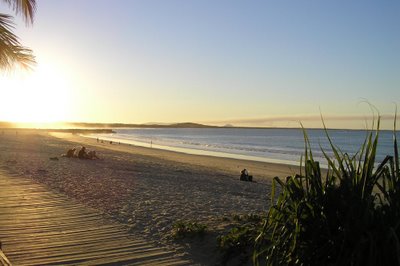
A pretty picture of Noosa Main Beach to break up the long post and remind you all how beautiful the planet can be and why it's so important that we do what we can to preserve it. I didn't actually start writing this sentence with the intention of sounding like a hippie - it just came out that way.


Now for this week's tidbit, and before I go on may I remind you all that I am not a scientist, nor an expert but merely an interested layperson.

A brief and simplistic introduction to climate change as I understand it:


Climate change is caused by a general and global warming of air and sea surface temperatures as a result of increased levels of carbon dioxide in the atmosphere. Once referred to as Global Warming, it is now called climate change for a couple of reasons. Firstly, people living in cooler climates like the idea of warmer weather and so "global warming" does not quite relay the severity of potential consequences. Also, not everywhere will experience warming per se. Climate change may mean colder winters (the UK could suffer significant decreases in temperature in the extreme event of the Gulf Stream slowing down or stopping), wetter weather, more severe storms, rises in sea level leading to loss of land, worsening droughts. The symptoms are many and varied and nearly always nasty.

Some places will be affected more than others and climate change models nearly always focus on global rather than local changes. Global changes may sound small. For example, scientists currently predict a rise in temperature of between 1.4° and 5.8° Celsius for the period 1990-2100. In fact current observations show that the earth is warming at a rate of about 0.17°C per decade which would lead to a temperature slightly higher than 1.4°C (see World Climate Report blog.) . These temperatures may not sound very high but applied globally could mean a significant rise for some localities.

So how does the carbon dioxide get into the atmosphere? Primarily through the burning of fossil fuels, such as coal, oil and gas. The earth has a natural carbon cycle which ensures that carbon released through the decomposition of matter is then taken up again, for example by trees and plants. However fossil fuels, as the name suggests, are part of a much longer carbon cycle which occurs over millions of years and are the result of matter which decomposed millions of years ago. Thus we are releasing them back into the atmosphere faster than the short-term carbon cycle can absorb them. This is why some environmentalists are not convinced that planting forests as carbon "sinks" is an effective solution, as eventually the trees will die and release the carbon back into the atmosphere. The only way we can be sure to stop the release of carbon dioxide into the atmosphere and therefore stabilise (and eventually reduce) the levels (which are still increasing) is to stop burning fossil fuels. But this leaves us with a big problem to solve: just where do we get our energy from?

Of the fossil fuels we like to burn, coal (which many countries burn for electricity) is the biggest producer of carbon emissions, followed by oil and then gas. Gas in its natural, pre-burned form of methane, however, is twenty times worse as a contributor to global warming than carbon dioxide (http://en.wikipedia.org/wiki/Methane).

Climate Change Tip for the top - This week's tip for doing your bit:
If you work in an office (or have a PC at home) ALWAYS switch the monitor off before leaving for the day (or when you're not using your PC). Use your PC power saving settings to save power during the day. (Right-click on the desktop and select Properties then go to the Screen Saver tab. There should be a button marked Power...) Setting your PC to shut down the monitor, stand-by or hibernate after certain periods of inactivity will save energy. If you won't be using your PC for more than 8 hours then either shut it down or hibernate it. If you do this with your PC at home it should save you money too; running a PC costs 3.5c per hour (see reference 6 below) which would cost $306 per year if you left your PC on permanently. If you use it for three hours a day but switched it off at all other times you would save $268. I don't have similar figures for the UK but apparently leaving a PC monitor on all night wastes enough electricity to microwave six dinners (http://www.admin.ox.ac.uk/estates/environment/energyandw.shtml) and according to Scott Richards from power supply manufacturer Antec (see http://news.bbc.co.uk/2/hi/programmes/click_online/4929594.stm), "If a million PC users switched to a more efficient power supply, it would save almost the equivalent of 250 thousand litres of gasoline a day."

For more information see:

For help with the difference between stand-by and hibernate see:

Resources and Further Reading

This is all just information I have gathered into my head over the last couple of years so I can't pinpoint where all of it comes from. However, here is a list of resources that I have read which will provide further information:

  1. The Weather Makers by Tim Flannery
  2. High Tide by Mark Lynas (Mark's final chapter inspired me to write this post.)
  3. A Big Fix: Radical Solutions for Australia's Environmental Crisis by Ian Lowe
  4. Affluenza: The All-Consuming Epidemic by John De Graaf, David Wann and Thomas H. Naylor (I thoroughly recommend this book by the way.)
  5. Affluenza by Clive Hamilton
  6. Eco-Wise and Wealthy by Joanna Tovia
  7. www.realclimate.org
  8. www.marklynas.org
  9. www.greenpeace.org.au/climate/
  10. www.greenpeace.org.uk/gp_pollution/climate_change.cfm
  11. The Modern Scholar: Global Warming, Global Threat, a series of audio lectures by Professor Michael B. McElroy. This was what first stimulated my interest.

If I remember more I'll add them later.

(BANG! Ooops sorry. Just fell off my soap box.)